2026-11-07
Treatment Guide ② Ulthera Prime: 8 Questions to Ask Before Your First Session
A guide to eight questions to ask before your first Ulthera Prime treatment, covering device differences, how it works, shot counts, pain, results, treatment areas, and side effects.

Before your first Ulthera treatment, what should you ask?

Hello, this is Dr. Young-min Cho of Cheongdam Anz Dermatology Clinic.
In Treatment Guide ①, we outlined how Ulthera, Thermage, and Shrink differ.
Today, I would like to take a closer look at Ulthera alone.
For those in Cheongdam who are looking into Ulthera for the first time,
I have selected eight questions that are good to know before your consultation.

1. Are Ulthera, Ulthera treatment, and Ulthera Prime different devices?
Ulthera and Ulthera treatment are the same device.
Ulthera Prime is an upgraded version of the Ulthera device.
"Ulthera" is simply a shorter name for the Ulthera treatment.
"Ulthera Prime" is also a shorter name for the Ulthera Prime treatment.
The ultrasound screen on Ulthera Prime is wider than before.
The wider screen can help the doctor examine the skin layers and decide the treatment depth.
Cheongdam Anz Dermatology Clinic began using Ulthera Prime on March 17, 2025.
At Cheongdam Anz Dermatology Clinic, we currently use two Ulthera Prime devices.
However, just because the device is newer,
it does not automatically improve everyone's results.
That is why treatment planning remains important.
2. How does Ulthera treatment lift the skin?
Ulthera treatment uses focused ultrasound (MFU-V) to create tiny thermal coagulation points (TCPs) at the desired depth.
As the areas where these thermal coagulation points formed heal, new collagen is produced.
When people hear "lifting," they tend to picture the skin being pulled upward.
However, the changes from Ulthera treatment begin beneath the skin.
That is why the results often become more noticeable over time, rather than on the day of treatment.

Ulthera treatment tips come in different depths, such as 4.5mm, 3.0mm, and 1.5mm.
The deeper 4.5mm tip targets the area around the SMAS (fascial layer), while the shallower 1.5mm tip targets the dermis.
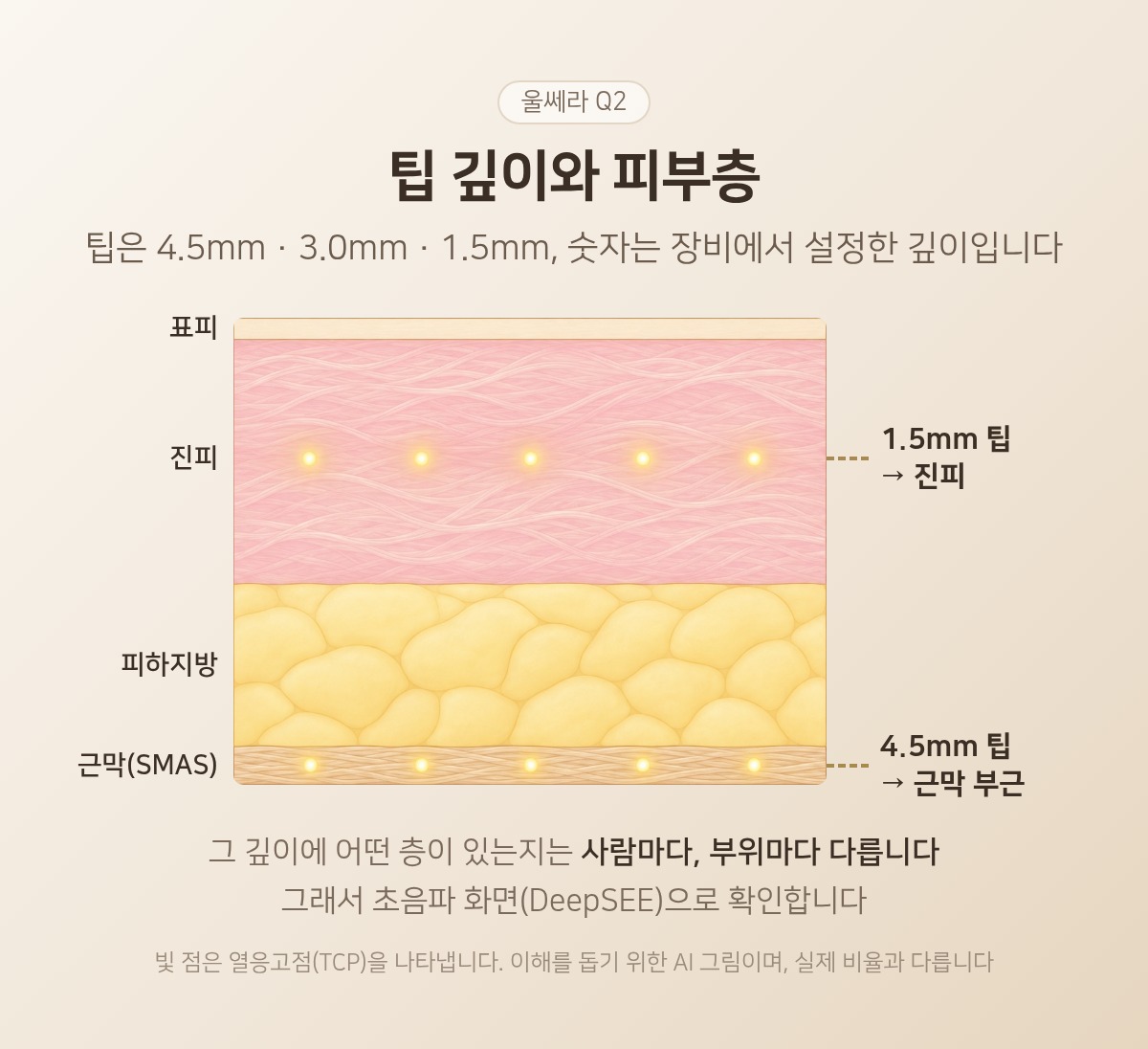
The number on each tip (mm) is the depth set on the device.
Which tissue layers sit at that depth varies from person to person, and even across different areas of the same face.
In my practice, I have seen many patients whose SMAS layer was not reached even with the 4.5mm tip.
That is why I check the skin layers on the ultrasound screen (DeepSEE) and decide the depth and area.
3. How many shots of Ulthera do you need?
There is no fixed number of shots that suits every face.
The number of shots depends on the treatment area, face size, underlying skin structure, degree of sagging, and how the treatment lines are arranged.
Even the same 600 shots can mean something different depending on where and at what depth they are delivered.

That is why I examine your skin first, then decide the treatment area, depth, and number of shots.
During your consultation, ask not only how many shots you will receive, but also where they will go and why.
4. Why do you keep Ulthera treatment records?
We keep Ulthera treatment records to review past treatments and plan the next steps.
At Cheongdam Anz Dermatology Clinic, we record which tips were used and how many shots were given.
When we track your progress over time, we can refer back to those records.
They also help guide how we divide tips and shots for your next session.

The Ulthera treatment device also saves log files.
However, if the records were reset or a loaner device was used due to a malfunction, log files may not be available.
If you would like to review the log files, please let us know before your treatment.
5. Does Ulthera hurt?
Ulthera treatment may cause pain during the procedure.
The pain may feel hot or tingling, or like a deep sense of discomfort.
How much pain people feel varies widely from person to person.
Some people get through the treatment with simple pain relief measures alone,
while others need more pain management.
If you are worried about pain, please let us know during your consultation before treatment.

6. When do the effects of Ulthera appear, and how long do they last?
The effects of Ulthera treatment often become more noticeable over about 2 to 3 months.
How long the results last varies from person to person; some people see results lasting around a year or longer.
The results appear gradually because it takes time for collagen to form.

Some people see only minimal changes, or almost none at all.
Non-surgical lifting treatments like Ulthera cannot produce the same results as lifting surgery, nor can they restore volume that has been significantly lost.
That is why I see Ulthera treatment less as a permanent solution,
and more as one part of a long-term approach to managing skin aging.
Whether to repeat Ulthera differs for each person.
Rather than simply repeating the same treatment, I review the areas, depths, and number of shots from your previous session and how much time has passed since then, then reassess your current facial condition before deciding.
Those who have already undergone many energy-based treatments, such as ultrasound or radiofrequency, may need a more cautious approach.
7. Which areas does Ulthera treat?
I consider Ulthera treatment for areas where sagging is the main concern, such as nasolabial folds, marionette lines, and a sagging jawline.
Ulthera treatment can also be applied to the deep cheek area and to the puffy area under the eyes (lower eyelid).
Whether to treat these areas is decided after an examination.
However, the causes of nasolabial folds and marionette lines are not limited to sagging alone.
They can also result from volume loss or changes in facial structure.
Wrinkles like these may be difficult to improve by addressing sagging alone.
We decide on the approach by looking at volume, sagging, and how they connect to the facial contour together.
8. Are there any side effects of Ulthera?
Ulthera treatment can also have side effects.
After treatment, you may experience temporary redness, swelling, and tenderness when pressed.
Occasionally, nerve-related symptoms such as changes in sensation may occur.
Burns, unwanted changes in facial contour, and other complications have also been reported with energy-based treatments.
Unwanted volume changes, such as facial fat loss or cheek hollowing after ultrasound lifting, have also been reported.
People with little facial fat or areas that are already hollow should be especially careful.
That is why I examine the structure of your face before treatment.
However, neither an examination nor the ultrasound screen can prevent every side effect or guarantee results, and it is also difficult to predict each person's individual risk precisely.
We will provide separate guidance on possible reactions and what to watch for after treatment.
If symptoms persist or worsen, or if you notice new changes in facial contour, please seek medical care.
Recovery is usually short, and many people return to daily life soon after, although swelling or tenderness when pressed may occur.

At a Glance
Question | Quick Answer |
Ulthera and Ulthera Prime | Ulthera = Ulthera treatment; Ulthera Prime is an upgraded device with a wider screen |
How it works | Focused ultrasound (MFU-V) creates thermal coagulation points (TCPs) at the desired depth |
Number of shots | No fixed number; area, depth, and shot count are decided after examination |
Treatment records | Tips and shot counts are recorded and referenced when planning the next session |
Pain | Varies by person; if concerned, discuss before treatment |
Results and duration | Results often become noticeable over about 2–3 months; duration varies, and some people see minimal change |
Areas | Nasolabial folds, marionette lines, sagging jawline, deep cheeks, and the puffy area under the eyes (lower eyelid) may be considered; whether to treat is decided after examination |
Side effects and daily life | Temporary redness, swelling, and tenderness when pressed; occasional nerve-related symptoms; burns, contour changes (fat loss, cheek hollowing), and other complications have been reported. Seek care if symptoms persist or worsen, or if new contour changes appear. Many people return to daily life soon |
If this is your first time, ask these three things during your consultation:
① Where the treatment will be applied, and why that depth is used
② How you can review your treatment records
③ How pain will be managed, and what to watch for after treatment

Ulthera is a widely known device.
However, the device name alone does not tell you whether a treatment is right for your face.
If this is your first time, ask these three questions first and check whether the plan suits your face.
If you have any questions, feel free to reach out via KakaoTalk below!
http://pf.kakao.com/_PxoxnQb/chat
Cheongdam Anz Dermatology Clinic is located on the 6th and 7th floors of Emporia Building, 220 Dosan-daero, Gangnam-gu, Seoul.

This article is provided for general medical information only. Treatment effects, duration, pain, and side effects may vary depending on individual conditions and treatment factors, so please make decisions after a thorough examination and consultation. |
Frequently Asked Questions
Are Ulthera and Ulthera Prime different devices?
Ulthera and Ulthera treatment are the same device, and Ulthera Prime is an upgraded version of it. "Ulthera Prime" is a shorter name for the Ulthera Prime treatment. Its wider ultrasound screen can help determine the treatment depth.
How does Ulthera treatment lift the skin?
Ulthera treatment uses focused ultrasound to create small thermal coagulation points at the desired depth, and new collagen forms as those areas heal. The changes begin beneath the skin, so they often become more noticeable some time after treatment rather than on the day itself.
How many shots of Ulthera do you need?
There is no fixed number of shots that suits every face. The number depends on the treatment area, face size, underlying skin structure, degree of sagging, and how the treatment lines are arranged. Even the same number of shots can mean something different depending on where and how deep they are delivered, so during your consultation, ask not only how many shots you will receive but also where they will go and why.
Does Ulthera treatment hurt during the procedure?
Some pain may be felt, and how much varies widely from person to person. The pain may feel hot or tingling, or like a deep discomfort. Some people manage with simple pain relief measures alone, while others need more pain control. If you are concerned, please mention it during your consultation before treatment.
When do the effects of Ulthera appear, and how long do they last?
Results often become more noticeable over about 2 to 3 months. Duration varies: some people see results lasting around a year or longer, while others see minimal or almost no change. Because Ulthera is a non-surgical lift, it cannot produce the same results as lifting surgery or restore volume that has been significantly lost.
What are the side effects of Ulthera treatment?
Ulthera treatment can have side effects, such as temporary redness, swelling, and tenderness when pressed after treatment. Occasionally, nerve-related symptoms such as changes in sensation may occur, and burns and unwanted contour changes have also been reported. If symptoms persist or worsen, please seek medical care.