2026-10-30
Treatment Guide ① Ulthera vs. Thermage vs. Shrink
Compares Ulthera, Thermage, and Shrink by energy type, target skin layer, and whether ultrasound imaging is used during treatment, with tips on choosing between them.
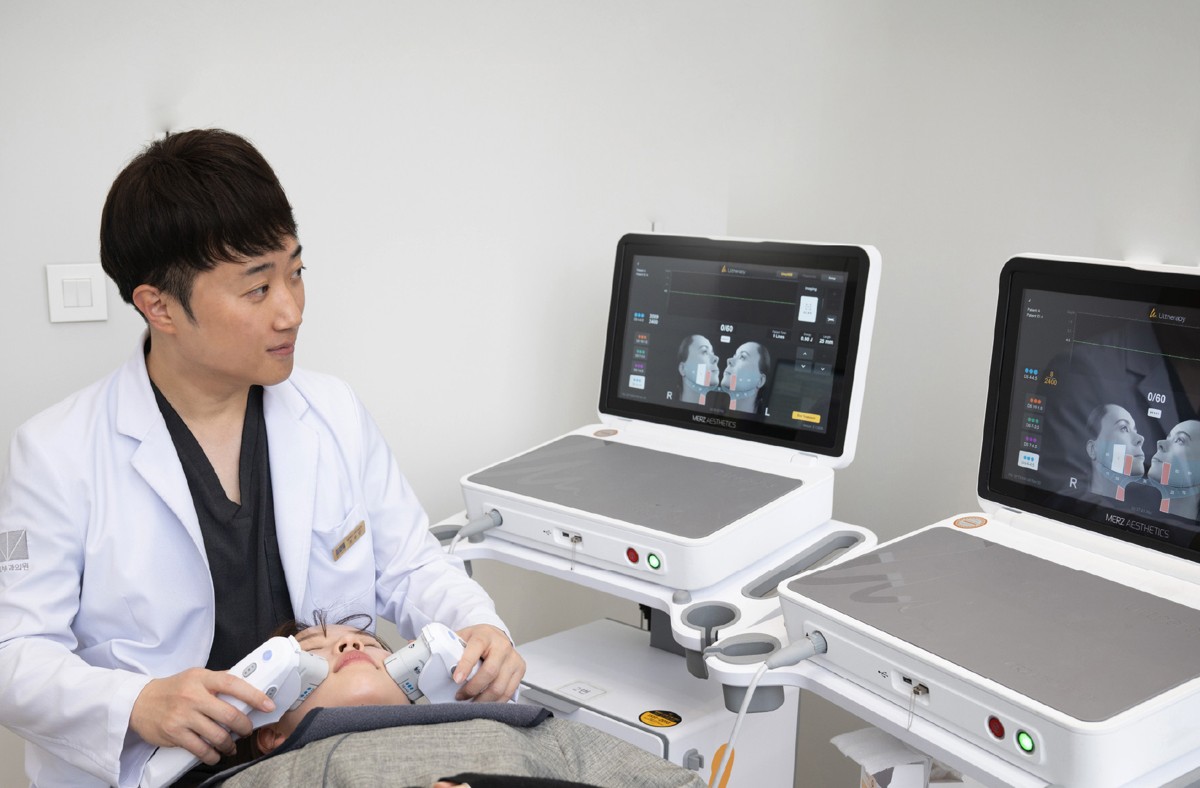
How are Ulthera, Thermage, and Shrink different?

Hello, I’m Dr. Cho Young-min.
There is a question I hear several times a day at my consultation room.
“Doctor, what’s the difference between Ulthera, Thermage, and Shrink?”
You’ve probably heard all of the names,
but many people have never really had someone explain how they differ.
Today, I’ll break down these three devices using three simple questions.
What kind of energy does it use?
Which layer does it mainly target?
Can you view the inside of the skin on a screen during the treatment?
If you remember just these three points, you’ll find it much easier to follow when you consult with a clinic.
First, let me show you the devices.
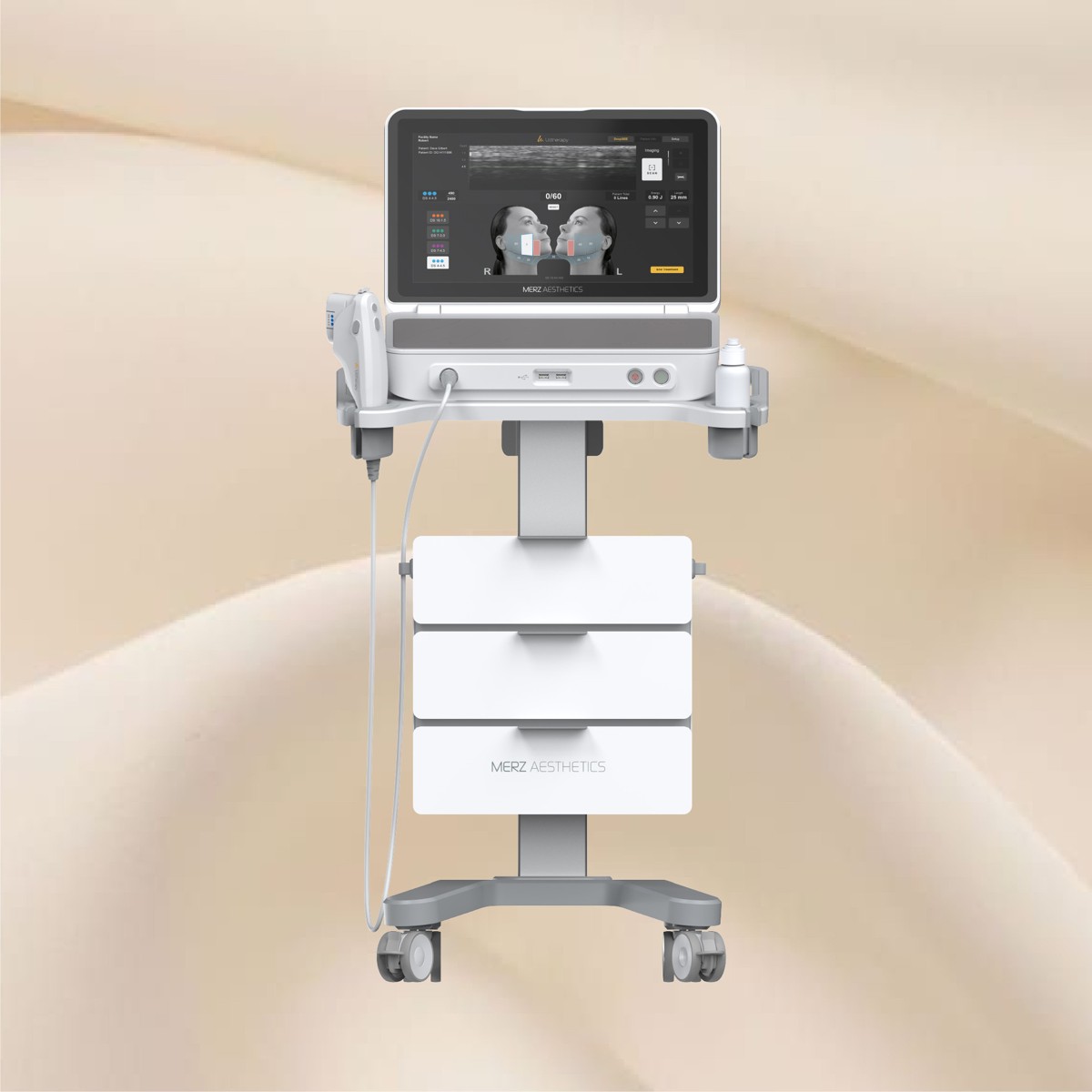
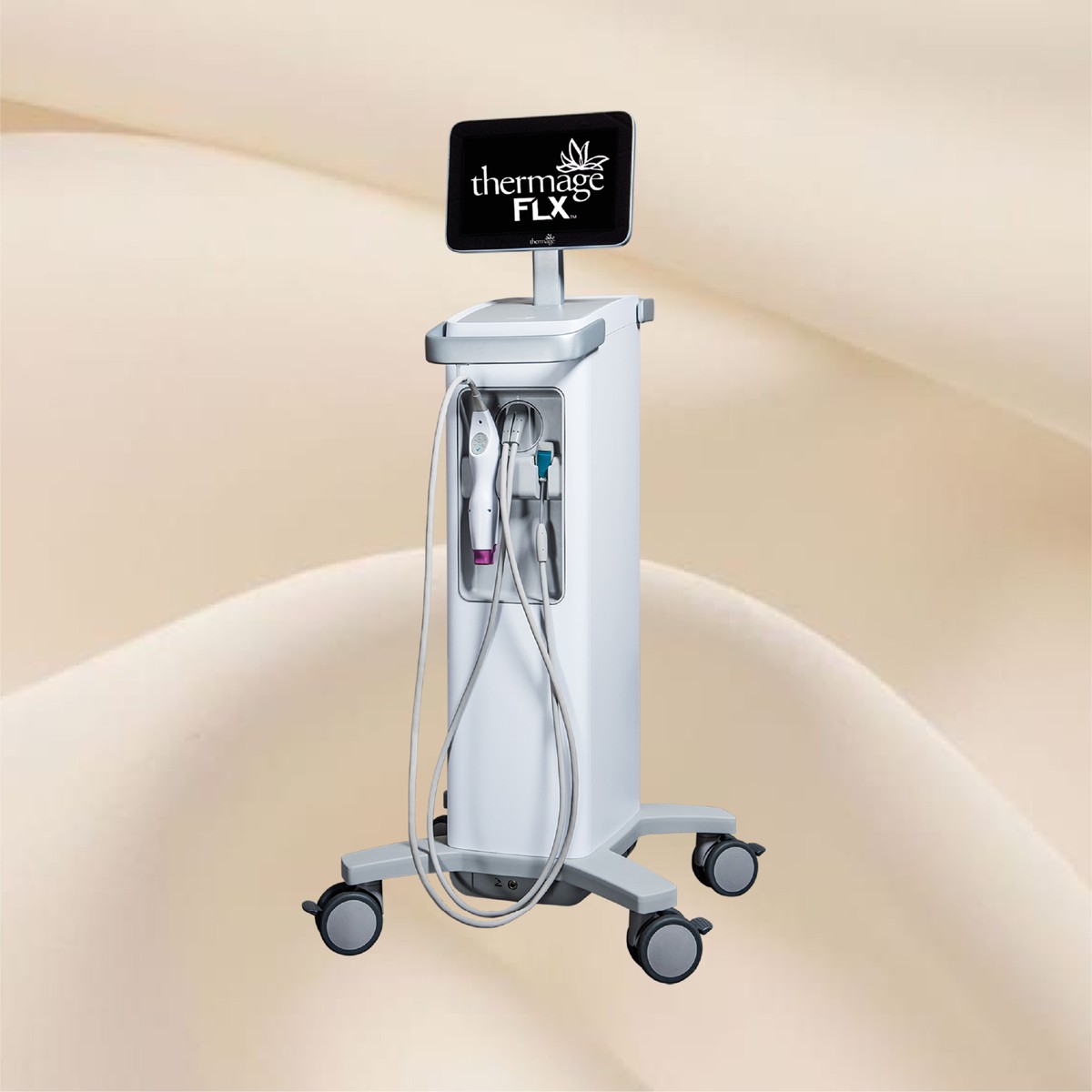
Question one: What kind of energy does it use?
Ulthera therapy (the device long known simply as Ulthera) and Shrink are both ultrasound devices.
Remember using a magnifying glass as a child to focus sunlight and burn a piece of paper?
Only the single spot where the light converges gets hot.
Ultrasound works the same way: when it is focused on one point inside the skin, a small heat spot forms right there.
This is called focused ultrasound,
commonly known as HIFU.
Thermage, by contrast, uses radiofrequency (RF) energy.
Rather than focusing energy on a single point,
it cools the skin surface while warming the dermis beneath it over a broad area.
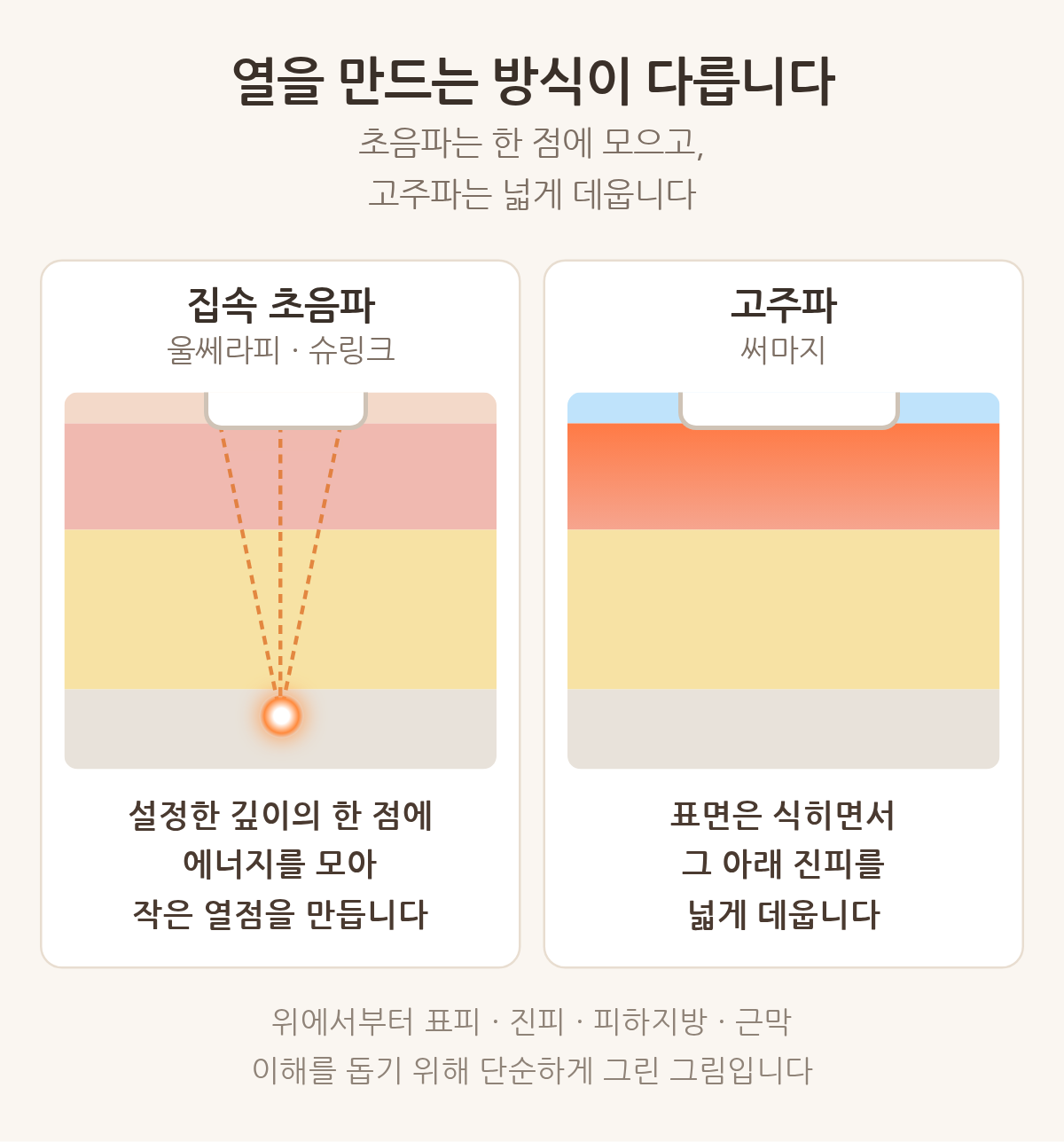
Ulthera and Shrink, which use ultrasound,
and Thermage, which uses radiofrequency.
That is how they split at the first question.
Question two: Which layer does it mainly target?
Facial skin is layered from the top down: epidermis, dermis, subcutaneous fat, and then the SMAS (superficial musculoaponeurotic system).
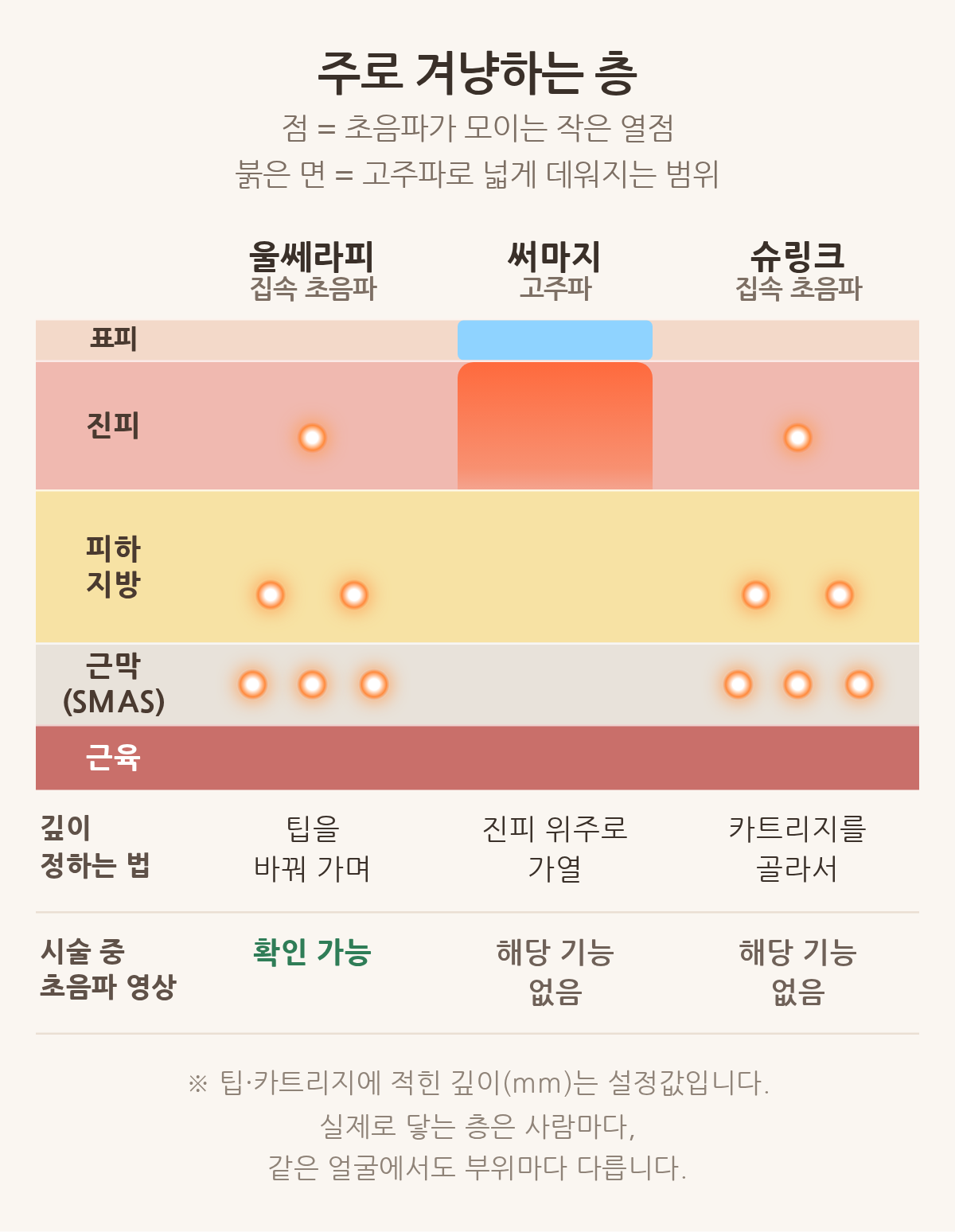
Ulthera uses tips of different depths, such as 4.5 mm, 3.0 mm, and 1.5 mm, switching between them as needed.
The deeper tips target the area near the SMAS,
while the shallower tips target the dermis.
However, the number printed on each tip is the set depth.
Even with the same 4.5 mm tip, the layer at that depth differs from person to person, and from area to area on the same face.
That is why which tip to use, and where, is decided after examining the skin.
Thermage mainly targets the dermis.
This is the layer where collagen is concentrated.
The heat stimulus causes existing collagen to change and new collagen to form, with the goal of improving firmness, fine lines, and skin texture.
Shrink is also a focused ultrasound device, like Ulthera.
It uses cartridges of different depths, such as 1.5 mm, 3.0 mm, and 4.5 mm, selected as needed.
The depth printed on the cartridge is also a setting, so the layer actually reached varies by person and by area.
Depending on whether your concern is sagging and the jawline or skin firmness and fine lines,
the areas we examine also differ.
That said, rather than choosing a device based on one concern alone,
we need to assess the overall condition of the skin.
Question three: Can you see the inside of the skin on a screen during treatment?
Ulthera and Shrink are both ultrasound devices, but they differ on this point.
With Ulthera, you can check the structures beneath the skin on an ultrasound screen during treatment.
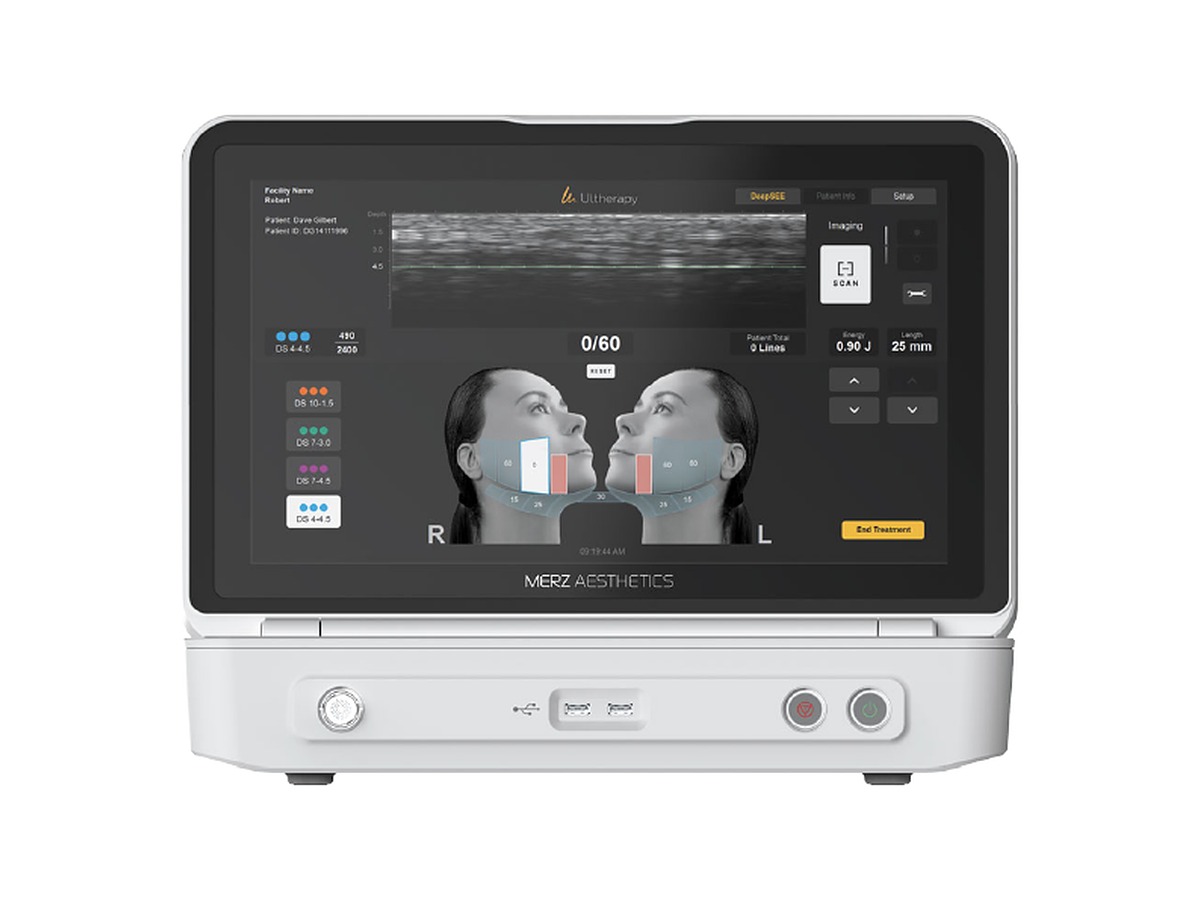
The gray band at the top of the screen is the ultrasound image showing the inside of the skin.
While watching the structures below the skin on the screen,
we adjust the depth where the heat point will be placed and the tip, and proceed one shot at a time.
Thermage is a radiofrequency device without an ultrasound imaging function.
The tip is pressed firmly against the skin to warm the dermis,
and the intensity is adjusted while monitoring the skin’s response during treatment.
Shrink is not a method where treatment is performed while viewing an ultrasound image,
and the cartridge is chosen based on the treatment area and skin condition.
Even on the same face, the depth of each layer differs by area, and it can shift when body weight changes.
I choose Ulthera because it allows me to treat while directly checking each patient’s skin layers.
A quick comparison
Here is a single table summarizing everything so far.
Category | Ulthera | Thermage | Shrink |
Energy used | Focused ultrasound (MFU-V) | Radiofrequency (RF) | Focused ultrasound (HIFU) |
How heat is generated | Small heat spots at the set depth | Broad heating of the dermis | Small heat spots at the set depth |
Main target layer | Depends on tip depth Near SMAS to dermis | Dermis | Depends on cartridge depth Near SMAS to dermis |
Ultrasound imaging during treatment | Available | Not available | Not available |
Concerns commonly discussed in consultations | Sagging, jowls | Firmness, fine lines, skin texture | Sagging, firmness |
The layers in this table are a simplified summary to aid understanding.
The layer actually reached varies by person and by area.
So which of the three should you choose?
My answer to this question is always the same.
I look at your skin before the device name.
If sagging is your concern, such as nasolabial folds, marionette lines, or a sagging jawline, we consider Ulthera together.
If fine lines have increased and your skin has become thin and dry, we consider Thermage together.
Shrink is also a lifting device used to improve sagging and firmness.
At our clinic, we currently consult on these concerns with Ulthera.
We also consider facial volume, skin thickness, and any previous treatments.
We don’t choose a device based on a single criterion.
Many people have both sagging and firmness concerns.
Aging doesn’t tend to arrive neatly one layer at a time.
In such cases, we sometimes use both devices together.
Whether to combine them and in what order is decided after examining your skin.
Good to know before treatment
Redness, swelling, and pain after treatment vary in degree from person to person.
They also vary depending on the device, treatment area, and skin condition.
The timing when results appear and how long they last also depend on the individual and treatment conditions.
Because new collagen takes time to form,
these treatments do not complete all changes on the day of treatment.
That is why I first check your skin condition through an examination,
and then decide on the device, number of shots, and treatment plan.
What to look at before the device
Ulthera, Thermage, Shrink.
There are three names, but in the end the question comes down to one.
In which layer is my face changing right now?
Once you know that answer, choosing a device becomes simpler than you might think.
New devices come out every year,
but the order of examining the skin first never changes.
Even when the same device is used, I believe what matters most is examining each patient’s skin and building a treatment plan that fits.
If you have any questions, feel free to reach out via KakaoTalk below!
http://pf.kakao.com/_PxoxnQb/chat |
Frequently Asked Questions
Do Ulthera and Thermage use different types of energy?
Yes, they do. Ulthera uses focused ultrasound (MFU-V), while Thermage uses radiofrequency (RF). The two devices also generate heat differently: Ulthera creates small heat spots at a set depth, while Thermage heats the dermis over a broader area.
Are Ulthera and Shrink the same type of ultrasound device?
Yes, both are focused ultrasound devices. However, Ulthera allows you to check the structures beneath the skin with ultrasound imaging during treatment, whereas Shrink is not performed while viewing an ultrasound image.
Can you see inside the skin during Ulthera treatment?
Yes, with Ulthera you can check the structures beneath the skin on an ultrasound screen during treatment. While watching the screen, the depth of each heat point and the tip are adjusted, and treatment proceeds one shot at a time. Thermage is a radiofrequency device without an ultrasound imaging function, and Shrink is not performed while viewing an ultrasound image.
How do you decide which of the three devices to choose?
The basic principle is to examine your skin condition first, rather than starting with the device name. If sagging is your concern, Ulthera is considered; if fine lines have increased and your skin has become thin and dry, Thermage is considered.
Can you receive both devices together?
Yes. For people with both sagging and firmness concerns, the two devices are sometimes combined. Whether to combine them and in what order is decided after examining the skin.
When do the effects appear after treatment?
The timing of results varies by individual and treatment conditions, so it is difficult to give a fixed timeline. How long results last also differs. Because new collagen takes time to form, not all changes are complete on the day of treatment.