2026-11-06
Ulthera vs. Shrink: Key Differences
A Cheongdam Anz Dermatology physician explains why Ulthera's real-time imaging gives more precise fascia targeting than blind-fire Shrink, based on fascia depth varying by person and area.
What Ulthera and Shrink Have in Common
Both devices use ultrasound, commonly called HIFU (high-intensity focused ultrasound). Rather than simply emitting ultrasound, they focus high-intensity energy to target only a specific layer.
For lifting, the primary target is the fascia. When energy is delivered to the fat septa, it can also produce tightening and fat-reduction effects, so it has a range of uses.
Ulthera is the original device, while Shrink is a domestic copycat of Ulthera.
There are many other devices besides Shrink, but Shrink is the most widely adopted, so I chose it for this comparison.
Differences between Ulthera and Shrink
Technically, this is less a difference and more a feature that only Ulthera has.
Ulthera emits two types of ultrasound.
One is for delivering energy to the target layer, just like Shrink. The other is a visualization ultrasound that lets you see the skin layers in real time.
As far as I know, the patent has not yet expired, and this is the biggest reason Ulthera holds such a unique position.
Put another way, Ulthera vs. Shrink comes down to shooting while watching vs. shooting blind.
I think that's a fair way to put it.
You might wonder why this matters. Can't an experienced practitioner just tell by looking at the patient?
Even I, having performed Ulthera on thousands of people, often find that the ultrasound monitor contradicts what I expected. It happens countless times.
I thought, “A rugged, burly man must have deep fascia!” But in reality, some have the fascia of a young girl.
I thought, “A slender, delicate woman must have shallow fascia!” But in some cases, the fascia barely reaches even at the deepest setting of 4.5 mm.
In other words, it's unpredictable. You absolutely have to look inside.
Even within the same person's face, fascia depth varies by area.
To write this post, I took reference photos myself.
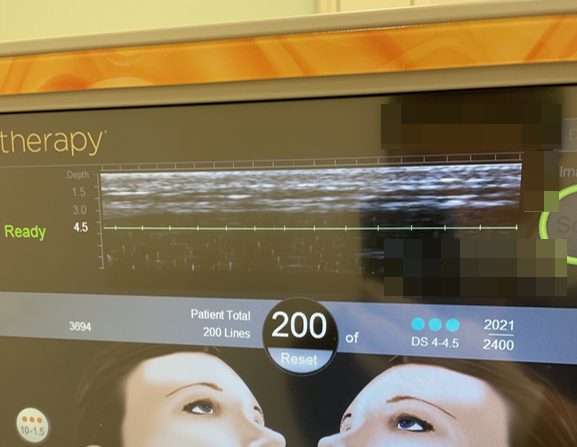
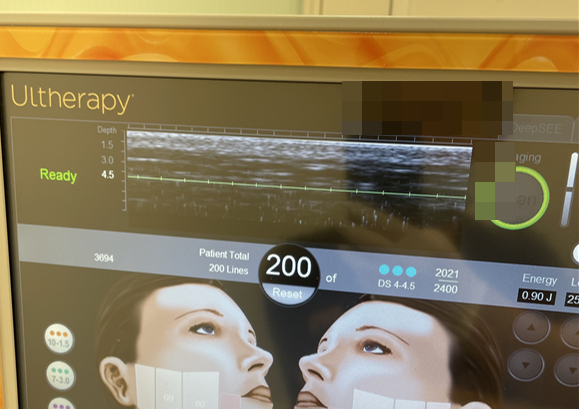
These are Ulthera ultrasound monitor images.
The image on the left was taken near one person's left jawline, and the image on the right was taken about 1 cm higher.
In the left image, the thick white line at a depth of 3.0 mm is the fascia, while in the right image, the fascia sits lower, at 4.5 mm.
This might be a bit hard to follow. To sum it up: fascia sits at different depths from person to person and area to area, so if you fire without looking, you can't reliably hit the correct layer.
Example 1: Suppose someone's fascia measures 3.0 mm across the entire face, as in the left image.
Shrink at 4.5 mm, 600 shots → no effect. Some deep fat is lost, which accelerates aging (worst-case scenario).
Shrink at 3.0 mm, 600 shots → lucky break, effective.
Split evenly between 4.5 mm and 3.0 mm → only the effect of 300 shots of Shrink. Likely ineffective.
Example 2: Suppose someone's fascia measures 4.5 mm across the entire face, as in the right image.
Shrink at 4.5 mm, 600 shots → effective.
Shrink at 3.0 mm, 600 shots → doesn't reach the fascia. Lifting effect drops.
Split evenly between 4.5 mm and 3.0 mm → 300 shots to the fascia + 300 shots to fat.
Example 3: In fact, both photos were of the same person's face. Assume that, anatomically, the fascia is split evenly between 3.0 mm and 4.5 mm.
Shrink at 4.5 mm, 600 shots → effect of 300 shots on the fascia + higher risk of accelerated aging.
Shrink at 3.0 mm, 600 shots → effect of 300 shots on the fascia + 300 shots on fat.
Split evenly between 4.5 mm and 3.0 mm → if each half lands on the fascia as shown in the diagram, you get the effect of 600 shots; but if they land the other way around, it's the worst case..
(With Ulthera, you can aim each half onto the fascia as shown in the diagram.)
This is how it plays out.
However, because Ulthera lets you fire while watching the screen, you can hit the target every time (of course, you have to keep your eyes glued to the monitor, right?)
With Shrink, the results are random: sometimes it's effective, and sometimes there is no effect at all.
That's why people say one Ulthera session is better than several Shrink sessions.
I actually agree.
This post was written on the assumption that the two devices deliver the same output. I also wonder whether devices made by different companies really produce identical output.
Everyone's fascia depth is partly inherited, but it also changes with weight fluctuations and varies by anatomical location, so it must be checked during each treatment.
There are also areas where 4.5 mm should not be used. This applies to both Ulthera and Shrink.
I'm afraid of accelerating someone's aging, so I don't perform blind treatments like Shrink.
That said, I do wonder whether those who blast away with Shrink with the boldness of a lion really consider the areas where 4.5 mm should not be used.
* I wrote this myself a few months ago on an online community :) I hope it was helpful.
#UlteraVsShrinkDifference #BestUlteraClinic #CheongdamAnzDermatology #GangnamGuDermatology #DirectorChoYoungMin
Frequently Asked Questions
What do Ulthera and Shrink have in common?
Both are HIFU (high-intensity focused ultrasound) devices. They focus high-intensity ultrasound to target only a specific layer, and the primary lifting target is the fascia. The post explains that when energy is delivered to the fat septa, tightening and fat-reduction effects can also be expected.
What is the biggest difference between Ulthera and Shrink?
The biggest difference is whether the practitioner watches the skin layers on a monitor during treatment. Ulthera uses a visualization ultrasound to view the skin layers in real time, alongside the ultrasound that delivers energy, whereas Shrink is a blind method that fires without viewing the layers. The author notes that, as far as they know, the patent for this feature has not yet expired.
Does fascia depth vary from person to person?
Yes, the post explains that fascia depth differs by person and by area. Even within the same face, depth can vary from one spot to another, and the author stresses that because it is hard to predict from appearance alone, it must be confirmed directly on the monitor.
Is one Ulthera session better than several Shrink sessions?
The author personally agrees that one Ulthera session is better than several Shrink sessions. The reason, they explain, is that with blind firing it is hard to match fascia depth, so results can be random or may not appear at all.
Could blind Shrink treatments accelerate aging?
Yes. The author is concerned that delivering energy to the wrong layer could accelerate aging, which is why they do not perform blind-method treatments themselves. They also explain that there are areas where 4.5 mm should not be used, and that this applies to both Ulthera and Shrink.